Julian, a project manager.
A meeting gets tense and he feels his jaw tighten. This time, he takes a breath before he answers.
Everyday Practices for Gratitude, Calm & Clarity
When your mind's busy and your phone keeps buzzing, this book gives you small, simple ways to find some calm.
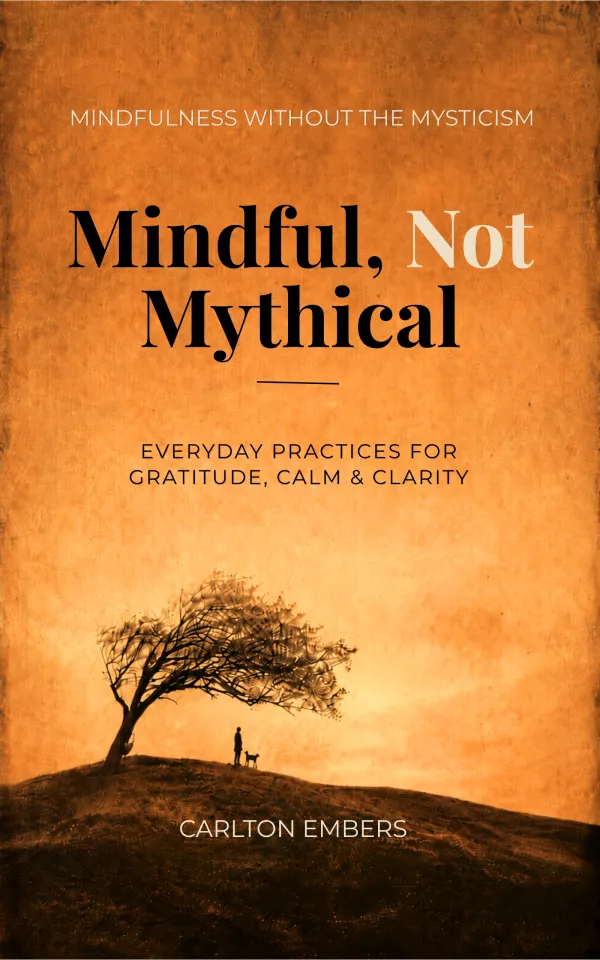
Mindful, Not Mythical is a practical guide to mindfulness for a hectic life, with bite-size practices from 10 seconds to 15 minutes and the science explained in plain words.
Mindfulness means noticing what's happening right now, in your body, your thoughts and the world around you. It comes down to a few small skills:
All together, these give you a moment to pause and choose what to do next.
You'll meet four people in the book. Each one is a mix of several real people, so you might see a bit of yourself in them.

A meeting gets tense and he feels his jaw tighten. This time, he takes a breath before he answers.

At his hospital bedside, she feels how scared he is, and some days she's scared too. But she talks him through what the doctor said.

Exams make her heart race. As she turns over her final paper, she takes three slow breaths to steady herself.

He's on the floor playing with his son, but his mind keeps drifting to tomorrow.
Two free guided mindfulness practices from the book. Each one takes three minutes or less. Find a quiet spot, press play and follow along.
Body Stress Scan
Notice where you feel stress in your body.
Use your senses to feel more present when you're stuck or overwhelmed.
If some senses are hard to use right now, use the ones that work for you.
Take care: If a practice makes you feel worse rather than calmer, you can stop at any time. Can mindfulness make me feel worse?
Resilient people don't get knocked down.
They do, the same as everyone else. They just get back up a bit quicker, and that's something you can practise.
I'm good at doing five things at once.
Your brain is really hopping from one thing to the next, and part of your attention stays on the last one. A slow breath before you switch can help.
Mindfulness should fix everything.
We all have difficult weeks. Mindfulness can help you notice when it's time to slow down or ask someone for help.
It takes 21 days to form a habit.
That number goes back to a surgeon in 1960, and he wasn't talking about habits. When researchers followed people starting a new habit, it usually took about two months, and missing a day didn't really set them back.
The amygdala, a small part of your brain, can sound the alarm before you've had time to think. Putting a word to the feeling seems to help it settle.
Lieberman et al. 2007Our minds drift away from what we're doing nearly half the time. So if yours wanders, you're not alone.
Killingsworth and Gilbert 2010A buzz or ping from your phone can break your focus, even if you don't pick it up.
Stothart et al. 2015After failing a test, people who were kind to themselves studied longer for the next one than people given a pep talk.
Breines and Chen 2012You can listen to eight of the book's practices and follow along. Two are free to play above. If you have the book, enter the code printed near the back to play the other six.
Not at all. Everyone's mind wanders. Each time you notice and gently come back, you're doing it right, even if it happens twenty times in five minutes.
Yes. A walk, a stretch or a cup of tea by the window can all be a chance to practise. Just pay attention to what you can see, hear and feel while you're doing it.
Less than you might think. Most of the practices in the book take a few minutes, and practising often seems to matter more than practising for long. If you miss a day, just pick it up again.
No. The practices in the book draw on Buddhist tradition, which goes back over 2,500 years, and the book treats those roots with respect. You can use them whatever you believe.
Most people find mindfulness helpful, and some find it doesn't do much either way. For some people, certain practices can stir up more than they expected, especially at first.
If you've lived through trauma or a very hard childhood, or had psychosis or dissociation, go gently, ideally with someone trained to work with trauma.
Pause if any of these keep happening:
If they do, try a shorter, gentler practice, or one where you move instead of sitting still. Or talk to a mental health professional.
Mindfulness can't make you fall asleep, but it can help you rest when your mind won't switch off. Lie still, rest a hand on your belly and breathe slowly. When your mind wanders off, notice it and come back to your breathing.
"Sometimes the most important thing in a whole day is the rest we take between two deep breaths."Etty Hillesum
Start with one practice, whenever it suits you. Over time, it can help you feel a little steadier on busy days.
View on Amazon